
So, you know what Nam-myoho-renge-kyo means but how do you even chant? What is your basic attitude, your posture, the tone and rhythm of your voice?
While taking into account each person’s situation, in essence, it is important to chant as though greeting the Buddha. Why? Because Nam-myoho-renge-kyo is equivalent to the name of your Buddha nature.
With the aim of developing an enjoyable and fulfilling daily Buddhist practice of reciting two portions of the Lotus Sutra (gongyo) and chanting Nam-myoho-renge-kyo, let’s keep in mind some practical points that’ll help as you get started.
Just to note: Contrary to popular belief, you’re not expected to clear your mind when you’re chanting. Actually, allowing your thoughts to naturally come up can also signal what’s in your heart. The important thing is to have a determination of some kind in whatever you’re facing.
First, let’s start with our posture
Shakyamuni Buddha said, “Sit upright and ponder the true aspect” (The Lotus Sutra and Its Opening and Closing Sutras, p. 390).
As singing coaches know, posture is key to the quality of the voice. Standing or sitting in a posture of confidence, even when we don’t feel so confident, can positively affect the brain and have an impact on our chances for victory.
When talking with someone we admire, we are more likely to sit upright, attentively and with our eyes open. The same applies when we view chanting as having a conversation with the Buddha.
When you first start chanting, you can find a space in your home with limited distractions and focus on the blank wall, for example.
It’s helpful to put your phone away, best to not be eating or covering your mouth when you’re chanting.
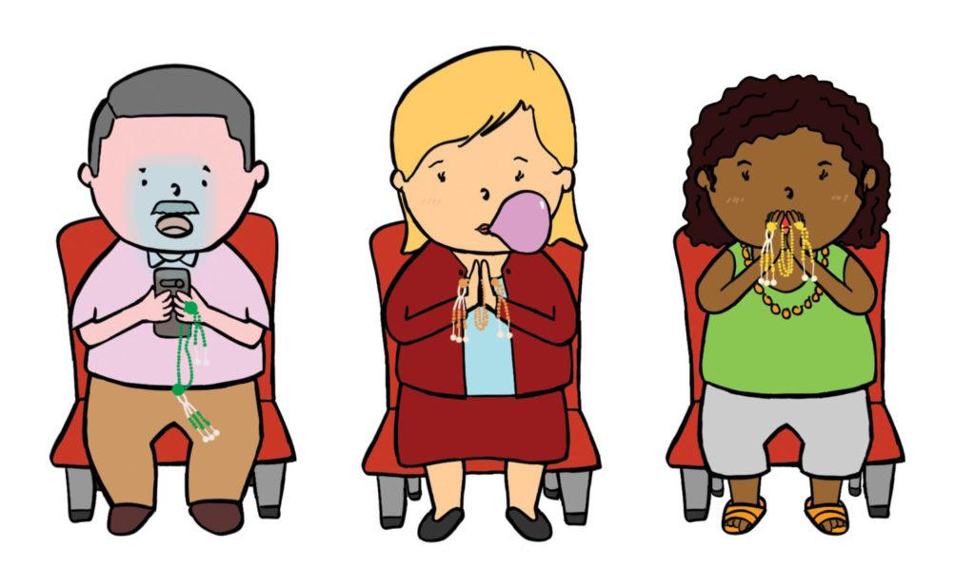
Illustrations by Ayumi Inoue
Second, there’s a rhythm to chanting
Whether speaking, singing or chanting, the voice, in essence, reflects the state of our bodies and minds, even the power of our lives.
The chanting of Nam-myoho-renge-kyo is not only the voice of faith of ordinary people; it is also the voice of Buddhahood. For that reason, we should always try to chant resoundingly, with a vibrant and vigorous rhythm like that of a galloping horse. It can also be said that the chanting of Nam-myoho-renge-kyo is an action by which we affirm that we ourselves are inherently entities of Myoho-renge-kyo.
On Attaining Buddhahood in This Lifetime: SGI President Ikeda’s Lecture Series, p. 21
In addition to a powerful, resounding voice, it’s important to chant with a consistent tone so that when you chant with other people, it can be harmonious.
As some final thoughts, you can chant sitting on the floor or in a chair. But most important, just try chanting on a daily basis, preferably in the morning and evening to see how it can impact your life. Let us know how it goes!

Illustrations by Ayumi Inoue
Check out your chanting tab on your app to chant-along and set daily or monthly goals! When you’re first starting out, chanting for even 2 minutes can feel long and no pressure on the length. Most important is how you feel. Have fun chanting!

Illustrations by Ayumi Inoue